

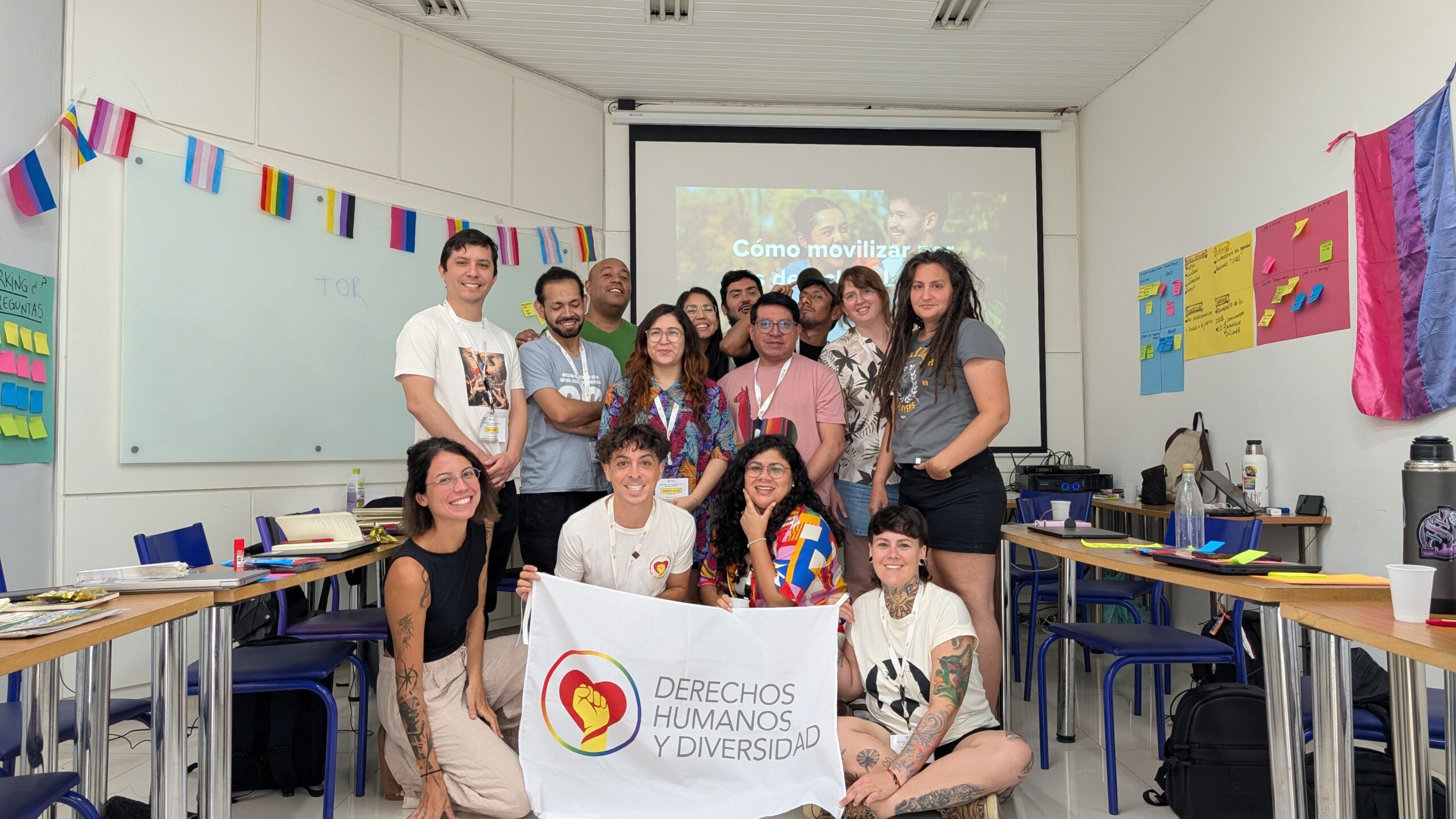
Mariano Ruiz on LGBTQI refugees, climate displacement and the funding gaps that put queer lives at risk
Growing up 3,000 kilometres from Buenos Aires in the Patagonian town of Rio Vallejos, Mariano Ruiz spent his teenage years being bullied for being different. ‘During all my teenage life, I was subject to bullying, violence and discrimination,’ he recalls. ‘I still didn’t know who I really was or why they saw me as different.’ It wasn’t until he moved to Buenos Aires at 18 that he began to find out. Coming out brought its own difficulties, but it also brought him into activism.
That experience shaped everything that followed. Today, Mariano leads Derechos Humanos y Diversidad (Human Rights and Diversity), an organisation he co-founded in 2022 to provide direct services to LGBTQI people forcibly displaced from their home countries. Many have fled state persecution, been denied healthcare, or found themselves without protection when climate disasters struck.
Argentina has made significant strides on LGBTQI rights, but a far-right government is now dismantling those gains, and the region’s most vulnerable communities are feeling it most. We sat down with Mariano to talk about the barriers facing LGBTQI refugees, why queer people are disproportionately harmed by climate disasters, and what it will take to close the gap between what funders offer and what movements actually need.
Could you tell us about the organisation’s founding and core mission?
In 2017, I was working at another organisation when we found ourselves helping the evacuation of around 10 Chechens, especially gay men, who were facing state-sponsored persecution in Russia. We brought them to Argentina as a safe route, and they eventually found home in Canada. At that stage, Argentina was considered a safe place to be, and they would have been able to seek asylum on the basis of being queer.
However, there was not a system or a mechanism for them to develop and integrate into society, because those integration services for asylum seekers were not developed. Since then, I started thinking that there was a need for an organisation that would serve forcibly displaced individuals, arriving in our country looking for a place to call home where their human rights could be respected just for being who they are.
So in 2022, together with a group of activists, who are like my best friends, we created this organisation with a focus of providing direct services to forcibly displaced individuals. We provide legal counselling, Spanish classes for people that can’t speak the language when they arrive, translation services for people to be able to access healthcare and basic services, and mental health support in three languages; Russian, English and Spanish.
What are some of the key barriers LGBTQI refugees encounter when seeking asylum, and how does your organisation support them?
It’s important to say that our organisation only supports people that have arrived in Argentina by themselves. Argentina lacks a resettlement system. There is no resettlement quota like many countries in Europe, the US or Canada. So the people we are able to assist are arriving through our borders by themselves, with or without a visa.
The main barrier is that we cannot receive every single nationality. Argentina applies strict visa requirements to certain regions, just based on prejudice, as many countries in the Global North do. Mostly we’re helping people that arrive from other regions in Latin America, or people that are able to make it to neighbouring countries where a visa is not required, and who then walk through the border and seek asylum there.
For people that don’t speak Spanish, the main barrier to accessing rights is the language. Even though the law states that the government should guarantee access to rights regardless of language, there are no resources for interpretation or translation services, free of charge. So our role is to try to lower those barriers for people to be able to integrate. It’s easier with our help and it would be really difficult without us. No one chooses to leave their home. Most of the people that we receive, if you ask them, did you choose to do this? They would say no. People don’t choose to migrate.
Could you talk about the connection between climate change and LGBTQI rights, specifically how LGBTQI people are disproportionately affected when a natural disaster happens?
While climate disasters affect entire communities, LGBTIQ individuals face additional barriers rooted in discrimination that existed before the natural disaster, but is exacerbated when one hits.
First, exclusion from disaster response. In my region, most relief and aid is carried out by churches, and churches in my region are the ones that discriminate against LGBTIQ individuals and trans people. So imagine a church is distributing water after a flood. Who will be the last ones to receive it? Our people.
Shelters are usually binary. What do we do with trans people? If shelters assign people according to their IDs, they are violating the rights of self-determination of trans and non-binary individuals.
There is also an increased risk of violence and exploitation. The chaos that follows climate disasters often leads to weakened legal protections. In countries where there are no legal protections for queer people, the risk of violence and discrimination will be higher and there will be fewer tools to fight back, making LGBTIQ people more vulnerable to gender-based violence, human trafficking and exploitation.
And then there are barriers to rebuilding and relocation. The first barrier for a trans individual trying to flee is their passport, the difference between the picture on the ID and who they are. For a trans individual trying to escape a natural disaster, everything will be far more difficult.
If people were already marginalised before a climate event, they are even less likely to receive government support to rebuild their lives. Donors and international organisations need to start looking at this intersection.
GiveOut hosted the world’s first LGBTIQ climate convening, bringing together activists and funders to collaborate on this work. Why are spaces like this so important?
These spaces are key for activists. It’s a unique opportunity to talk to funders, to try to align the objectives of funders to the needs of communities. Many times we get calls for funding opportunities where what the funder is looking to do is not related to what’s needed on the ground. These spaces help address that gap.
In my region, all funding opportunities around climate change will focus on women, but they would not mention queer people, or they will focus on energy transition and not emergency relief.
While I was at the convening, there was a flood 600 kilometres from Buenos Aires, and I got a message from a trans person asking if we could help her because she had lost her house. Unfortunately, the funding we have prevents us from doing that. With a network of organisations, we started collecting donations from individuals to support those affected. But it would have been much easier with an emergency relief fund, one that could say, here’s money for a hotel for a few nights, here’s money for food. Those funds do not exist in Argentina today.
Our role is to share these stories so that they start to exist, and so that donors start paying attention to what our communities actually need. Energy transition is important, but we also need money for emergency relief when a climate disaster strikes.
What keeps you hopeful and motivated in your activism?
Looking back at how my life was when I was a teenager and how it is today, things have changed a lot. But this is also a lesson: we need to be more united, to speak more intersectionally with other organisations, other social movements, and to stop only talking among ourselves.
The only way to turn this around is to advocate together with other minorities: with feminism, including trans individuals, with climate justice movements. We need to start thinking about what kind of society we want to build as a whole, and the only way to do it is together. The best approach is to build international and cross-national solidarity — not only within the LGBT movement, but by engaging with other causes and other activists that are putting their lives at risk every single day to make this world better.
To explore more of Derechos Humanos y Diversidad’s vital work and to learn more, go here.