

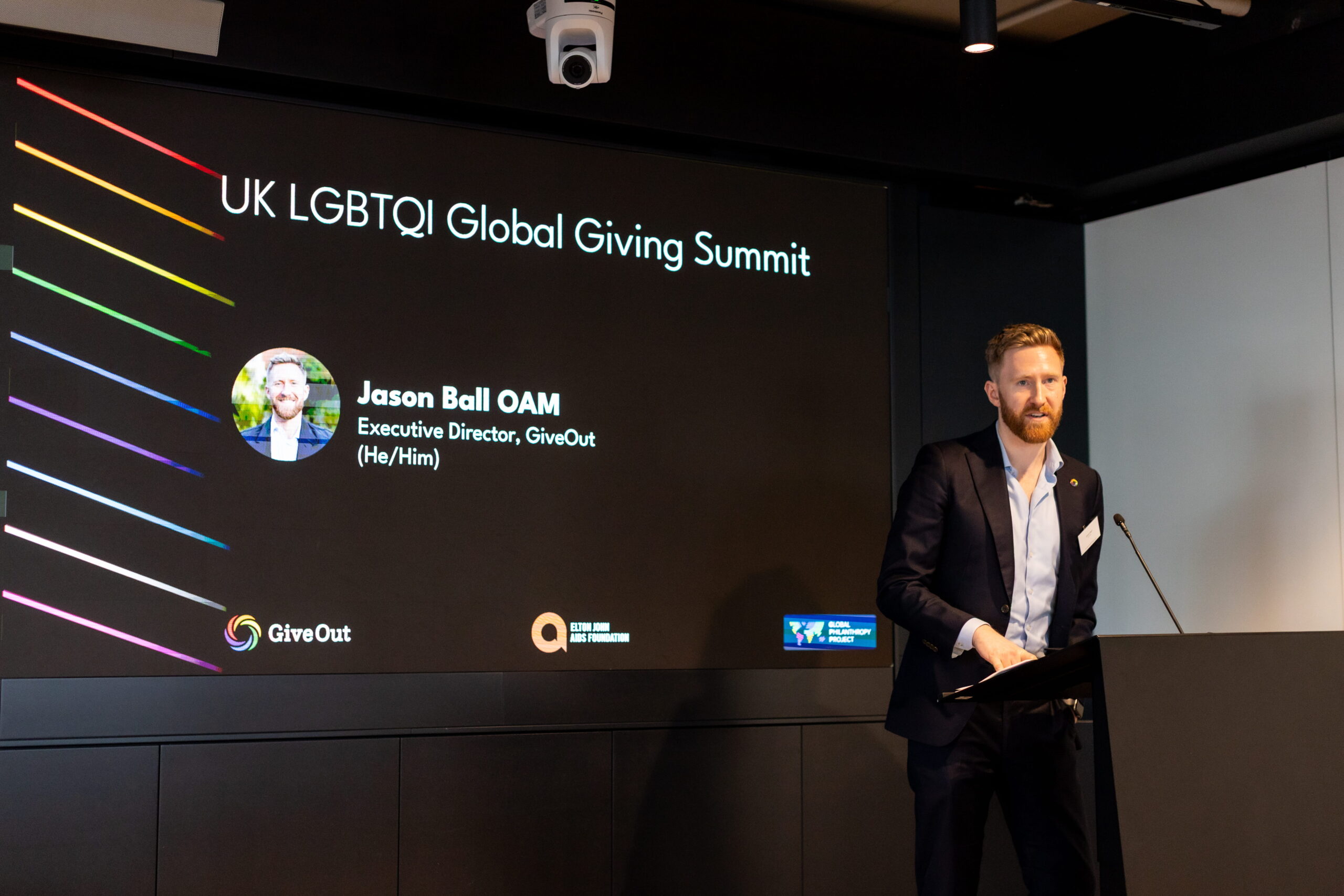
By Jason Ball, Executive Director of GiveOut
This is a hard moment for LGBTQI communities worldwide.
Across continents, hard-won rights are being rolled back. Criminalisation is rising. Human rights defenders are being targeted. Anti-rights movements are becoming more coordinated, better funded, and more sophisticated in how they weaponise fear and disinformation.
Meanwhile, the funding that sustains frontline LGBTQI organisations, those who provide safe housing, legal defence, crisis response, HIV prevention and care, and strategic advocacy to advance and defend rights, is becoming more fragile and unpredictable, especially since the abrupt withdrawal of USAID.
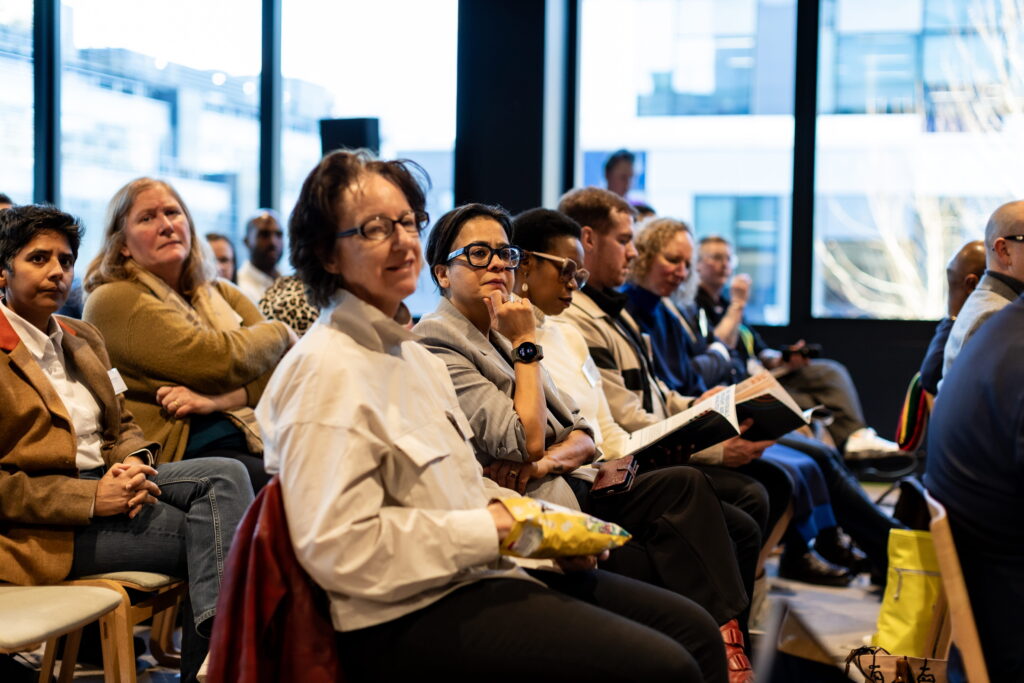
That was the reality in the room at the second UK LGBTQI Global Giving Summit held this month, where leaders from government, philanthropy, business and civil society came together in London to focus not just on the scale of the challenge, but on what a serious response looks like.
In a statement shared with Summit participants, Elton John and David Furnish captured both the urgency and the wider stakes. They warned of a funding freefall for LGBTQI health and rights organisations, and reminded us that leading on equality isn’t only morally right; it’s strategically smart. Human rights strengthen global stability, health security and democracy itself, nowhere more clearly than in the fight against HIV.
That point matters because the case for supporting LGBTQI rights extends far beyond LGBTQI communities.
When anti-rights actors succeed in scapegoating minorities, they rarely stop there. They target women’s rights, reproductive health, independent civil society, the media, and the rule of law. Attacks on LGBTQI people are often an early warning sign of wider democratic regression, a test case for how far exclusion and authoritarianism can be pushed.
As Alex Farrow argues in Context, Europe’s security depends on LGBTQI rights. Campaigns to roll back LGBTQI equality are frequently embedded in broader efforts to undermine pluralism and weaken democratic norms. In other words: this funding is not niche. It is part of the architecture that sustains democratic stability.
Two new pieces of research launched at the Summit to help clarify what’s at stake, and how we can focus our efforts next.
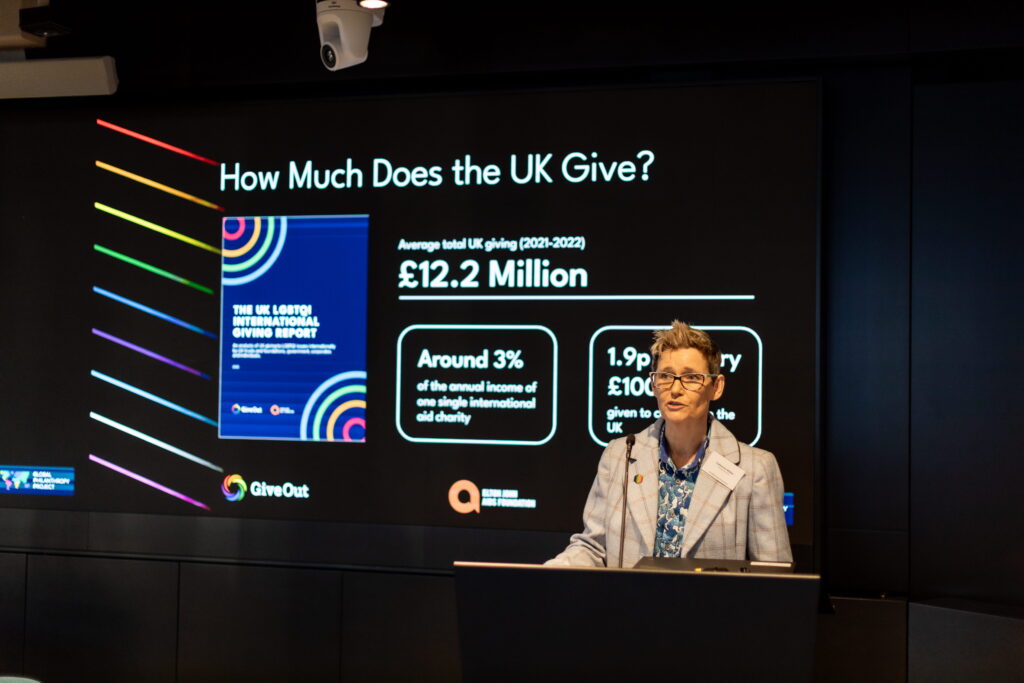
The UK LGBTQI International Giving Report shows that UK funding for LGBTQI issues internationally remains small, fragile and highly concentrated. In such a thin ecosystem, relatively modest shifts by a small number of donors can have outsized consequences; closures, layoffs, stalled reform, and fraying safety nets for communities under attack.
The second report, Community Is Resource: Reimagining LGBTQI Resourcing, highlights something equally important: LGBTQI movements are not simply waiting to be funded. They are already resourcing themselves, through mutual aid networks, pooled community funds, diaspora solidarity, volunteer labour, and informal infrastructures of care. The report makes visible practices that have long existed, often out of necessity, and too often overlooked by external funders.
These community-led systems are powerful because they are rooted in trust, legitimacy and shared responsibility. They are often the first line of defence when external funding disappears. But resilience has limits. A movement cannot survive indefinitely on volunteer labour and emergency transfers. Community-led resourcing must be complemented, not replaced, by predictable, strategic investment.
That is why the UK Government’s global LGBTQI rights programme matters, and why it must be protected.
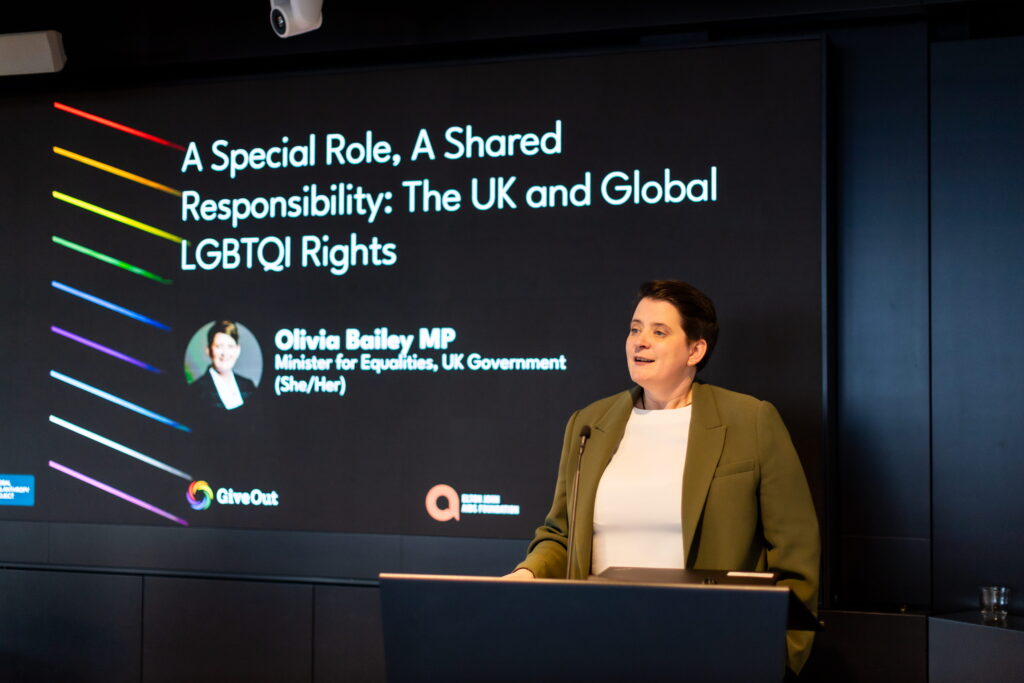
At the Summit, the government confirmed £2 million investment in the Equal, Safe and Free Fund, the UK’s flagship public–private partnership mechanism for supporting frontline LGBTQI organisations through trusted regional intermediaries in Sub-Saharan Africa, the Caribbean and the Pacific.
Alongside this, the programme includes GiveOut’s LGBTQI Solidarity Fund, a match-funding mechanism that matches donations from individuals, companies, trusts and foundations, multiplying private giving and helping resources reach organisations closest to the ground, including in contexts where direct funding can be difficult or unsafe.
Together, these sit within the £40 million, five-year commitment announced at the previous Summit. In the context of the overall aid budget, it is a small investment. In the context of LGBTQI rights globally, it is hugely impactful, precisely because it is catalytic and partnership-driven. And yet we know the UK’s foreign aid budget is under pressure. If this commitment is reduced or cut short, it will not be a tidy administrative adjustment: it will be an immediate shock felt first by grassroots organisations in the most hostile environments.
Finally, we also need to adapt. That’s why GiveOut and the Global Fund for Community Foundations launched the Reimagining LGBTQI Resourcing Fund at the Summit, a new initiative to help LGBTQI groups strengthen local fundraising strategies, build diaspora giving pipelines, and diversify resources over time, reducing vulnerability to future funding shocks.
Supporting LGBTQI rights is not only about one community. It is about public health, civic space, and democratic resilience. Community is the resource. The question now is whether we are prepared to invest in it, strategically, consistently, and at the scale this moment demands.